
Have you cracked a molar on a piece of hard candy, or chipped a front tooth when you tripped on the stairs? Or maybe years of grinding have worn down a tooth until it needs protection. You need a dental crown.
Whatever the reason, you probably assume a crown is a crown. You pick a material, the dentist makes it, and they cement it in place. Simple, right? Not exactly.
A crown on your front tooth and a crown on your back tooth serve completely different purposes. They’re shaped differently, made from different materials, and designed to handle different forces. If your dentist treats them the same way, you could end up with a crown that looks great but fails early, or one that lasts forever but never quite looks right.
At Dazzling Dentistry, Dr. Margaret Radziszewski and Dr. Weronika Dabros understand this distinction. Together, they’ve placed thousands of crowns in Chicago and Arlington Heights. They know front teeth and back teeth require different approaches. Let’s break down why.
The Job Description Is Different
Think about how you use your teeth. Your front teeth and back teeth don’t do the same work.
Front Teeth: The Cutting and Tearing Tools
Your front teeth, also called incisors and canines, are designed to cut and tear food. They also play a starring role in your smile. When you talk, laugh, or pose for a photo, your front teeth are on display.
That means a crown on a front tooth has two jobs. It has to function properly when you bite into an apple and look completely natural.
Back Teeth: The Grinding and Crushing Machines
Your back teeth, the molars and premolars, are your mouth’s workhorses. They grind and crush food with tremendous force. The average person generates 150 to 200 pounds of pressure on their back teeth while chewing.
A crown on a back tooth doesn’t need to look perfect, nobody sees it when you smile, but it needs to be incredibly strong. It has to withstand years of heavy chewing without cracking, wearing down, or breaking.
Dr. Radziszewski, who trained at the prestigious Dawson Academy and is among the top 10 percent of dentists in the U.S. with that training, explains it simply. “Front teeth are for show and for cutting. Back teeth are for power. A crown has to match the job.”
Material Selection: What Works for One Doesn’t Work for the Other
The material you choose for a crown matters enormously, and the right choice depends on where it goes.
Materials for Front Teeth
Front teeth are all about aesthetics. You want a crown that blends seamlessly with your natural teeth. That means:
- Porcelain: The gold standard for front teeth. Porcelain mimics the translucency of natural enamel. It reflects light like real teeth. It can be color-matched precisely to your surrounding teeth.
- Zirconia with Layered Porcelain: A newer option that combines strength with beauty. The zirconia core provides durability, while the porcelain layering creates a natural look.
Why Not Metal or PFM on Front Teeth?
Metal crowns and porcelain-fused-to-metal (PFM) crowns have a metal core. Over time, that metal can show through at the gum line. It can create a gray or dark line that shows when you smile or talk. For front teeth, that’s a dealbreaker.
Dr. Dabros, who trained at the Bioclear Learning Center in Seattle, notes that “patients care most about how their front teeth look. If a crown on a front tooth doesn’t match perfectly, they’ll notice every time they look in the mirror.”
Materials for Back Teeth
Back teeth need strength above all else. The material has to handle heavy chewing forces without failing. That means:
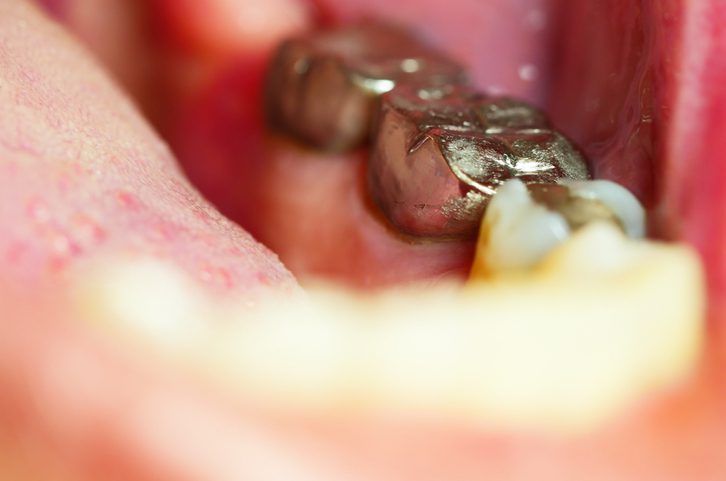
- Zirconia: An excellent choice for back teeth. It’s incredibly strong and fracture-resistant. It can handle the grinding and crushing forces that molars endure.
- Gold Alloys: Gold is soft, which sounds like a weakness, but it’s actually a strength for back teeth. It wears at a similar rate to natural enamel, so it doesn’t damage the opposing tooth.
- PFM (Porcelain-Fused-to-Metal): A middle-ground option. The metal core provides strength, and the porcelain provides acceptable aesthetics. It’s a practical choice for back teeth where appearance matters less.
Why Isn’t Porcelain Alone Ideal for Back Teeth?
All-porcelain crowns can be beautiful, but they’re more prone to chipping and cracking under heavy force. For a back molar that takes 200 pounds of pressure every time you chew, that’s a risk.
Dr. Radziszewski evaluates each patient’s bite forces before recommending a material. “If you grind your teeth, I’m going to recommend something stronger for your back teeth. Porcelain might look great, but it won’t survive.”
Shape and Contour: Function Follows Form
A crown’s shape isn’t just about looks. It affects how your teeth meet when you bite, how food moves through your mouth, and how healthy your gums stay.
Front Tooth Crown Shapes
Front tooth crowns are designed to look natural. That means:
- Translucency at the edges: Real front teeth are slightly see-through at the biting edge. A good crown mimics that.
- Subtle variations: Natural teeth aren’t uniform in color. They have subtle gradients and character. A skilled ceramist recreates that.
- Proper emergence profile: The way the crown meets the gum line matters. It should look like the tooth is growing out of the gum, not sitting on top of it.
Dr. Radziszewski is known for her artistic approach to dentistry. Patients describe her work as “works of art.” She pays attention to the tiny details that make a crown look real.
Back Tooth Crown Shapes
Back tooth crowns are designed for function. That means:
- Broad chewing surfaces: Molars have wide, flat surfaces for grinding. The crown needs to replicate that.
- Proper cusp height: The bumps and grooves on a back tooth guide food and help you chew efficiently. If they’re too high or too low, your bite feels off.
- Tight contacts: Back teeth touch each other on the sides. Those contacts need to be tight enough to prevent food from getting stuck, but not so tight that they cause pain.
An incorrectly shaped back tooth crown can cause jaw pain, headaches, and premature wear on other teeth. That’s why Dr. Radziszewski evaluates your entire bite before designing any crown.
Bite Forces: The Hidden Factor
Here’s something most patients never consider. The forces on your front teeth and back teeth are completely different.
Front Teeth Forces
When you bite into a sandwich, your front teeth experience shearing forces. These are horizontal forces that push the teeth sideways. They’re not as strong as the vertical forces on your back teeth, but they can still cause damage if the crown isn’t designed properly.
Back Teeth Forces
Your back teeth experience vertical compressive forces. These come from grinding and crushing. They’re much stronger than the forces on your front teeth. A back tooth crown has to be built to handle that pressure day after day.
Dr. Radziszewski’s Dawson Academy training includes a deep understanding of occlusion, which is how your teeth come together when you bite. She designs crowns that distribute forces evenly, protecting both the crown and the underlying tooth.
“If a crown is too high, it takes all the force,” she says. “If it’s too low, the neighboring teeth take the force. Either way, something fails. The goal is balance.”
The Cosmetic and Functional Divide
At Dazzling Dentistry, Dr. Radziszewski and Dr. Dabros take a comprehensive approach to every crown. They evaluate your entire chewing system.
- For Front Teeth: We focus on aesthetics and a natural appearance. Dr. Radziszewski considers your facial features, skin tone, and even your personality when designing a crown for your front teeth. The goal is a smile that looks like it was always meant to be there.
- For Back Teeth: Focus on function and durability. Dr. Radziszewski evaluates your bite forces, your grinding habits, and the health of the opposing tooth. The goal is a crown that lasts for decades without causing problems.
Both doctors work together to ensure every crown, front or back, meets the highest standards of form and function.
Serving Chicago, Arlington Heights, and Beyond
Dazzling Dentistry has two convenient locations!
Our Chicago office is located at 6941 W. Archer Ave., Chicago, IL 60638. We proudly serve patients from Garfield Ridge, West Lawn, Archer Heights, and surrounding neighborhoods.
Our Arlington Heights office is located at 102 S. Dunton Ave., Arlington Heights, IL 60005. We serve patients from Arlington Heights, Palatine, Mount Prospect, and surrounding communities.
We also serve a large Polish community. Many of our team members speak Polish, so you can feel comfortable communicating in your preferred language.
Schedule Your Crown Consultation
If you need a dental crown, don’t settle for a one-size-fits-all approach. Choose a dentist who understands the difference between front teeth and back teeth.
Dr. Radziszewski and Dr. Dabros at Dazzling Dentistry are ready to help. They’ll evaluate your smile, discuss your options, and create a personalized treatment plan. You’ll get a crown that looks natural, functions properly, and lasts for years.
Call (872) 276-8546 to schedule your consultation, or request an appointment online. We have two convenient locations in Chicago and Arlington Heights.
Your smile deserves the right crown for the right tooth.