
Losing a tooth from decay, injury, or gum disease can feel like a setback. But with today’s advanced dentistry, you have more options than ever to restore your smile, your confidence, and your oral health.
At Dazzling Dentistry, Dr. Margaret Radziszewski and Dr. Weronika Dabros help patients from Arlington Heights, Chicago, and surrounding communities navigate the journey from tooth loss to full restoration. The right solution depends on your unique situation, how many teeth are missing, the health of your remaining teeth and jawbone, your budget, and your long-term goals.
Here’s what you need to know about your options after tooth loss.
Why Replacing Missing Teeth Matters
It’s easy to assume that losing a tooth isn’t urgent. But the truth is, the effects of tooth loss ripple far beyond your smile.
Neighboring teeth shift. The teeth adjacent to the gap begin to drift into the empty space. This can lead to bite problems, uneven wear, and new areas where food can get trapped, increasing your risk of tooth decay and gum disease.
Your jawbone changes. Your tooth roots do more than hold teeth in place. They stimulate the bone every time you chew. When a tooth is lost, that stimulation stops. Over time, the jawbone begins to shrink, a process called resorption. This can change the shape of your face and make future tooth replacement more complex.
Your confidence suffers. Even a missing tooth in the back can affect how you chew. A missing front tooth affects how you smile, laugh, and introduce yourself. You shouldn’t have to adapt your life around a gap. Replacing missing teeth is about preserving your long-term oral health and quality of life.
Your Options for Replacing Lost Teeth
Modern dentistry offers several paths to restoring your smile. Each has its strengths, and the right choice depends on your specific needs.
Dental Implants: The Gold Standard
Dental implants in Chicago and Arlington Heights are the most advanced and durable solution for tooth loss. An implant is a small titanium post that Dr. Radziszewski or Dr. Dabros surgically places into your jawbone. Over several months, the bone fuses with the implant through a process called osseointegration, creating a foundation that’s nearly as strong as a natural tooth root.
Once healed, the implant is topped with a custom-made crown that perfectly matches your surrounding teeth.
Why patients choose implants:
- They stand alone. Implants don’t rely on neighboring teeth for support, so healthy teeth remain untouched.
- They preserve bone. Because the implant stimulates your jawbone, it prevents the bone loss that inevitably follows tooth loss.
- They last. With proper care, implants can last decades.
- They feel natural. You eat, speak, and smile with complete confidence.
Implants can replace a single tooth, support a bridge for multiple missing teeth, or even anchor full-arch restorations like implant-supported dentures.
The implant process takes several months from start to finish, and the initial investment is higher than that of other options. But many patients find that the long-term health, comfort, and durability benefits make implants the most cost-effective choice.
Dental Bridges: A Fixed Solution
A modern dental bridge does exactly what its name suggests: it “bridges” the gap created by one or more missing teeth. A bridge consists of an artificial tooth (called a pontic) held in place by crowns that are cemented onto the adjacent natural teeth.
Bridges offer several advantages:
- They’re faster than implants. The process typically takes two to three visits over a few weeks.
- They restore function quickly. You leave with a fixed, non-removable restoration.
- They’re a good choice when adjacent teeth already need crowns.
However, bridges do require reshaping the neighboring healthy teeth to support the crowns. And because they don’t replace the tooth root, they don’t stimulate the jawbone, so bone loss can still occur over time.
With proper oral hygiene, a well-made bridge can last 10 to 15 years or longer.
Complete Dentures: Full-Arch Restoration
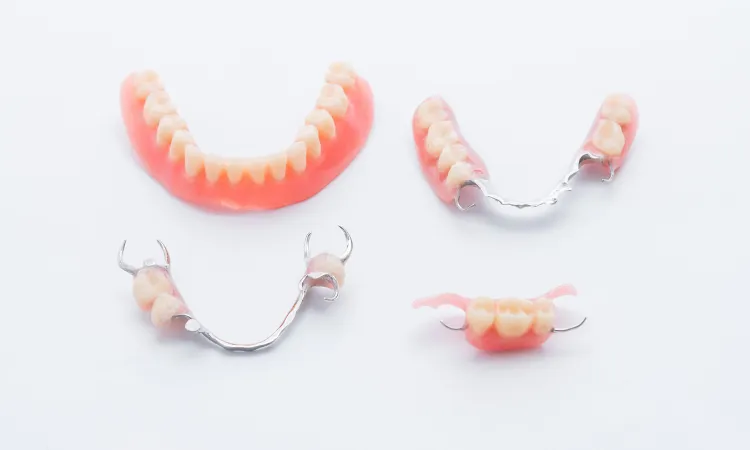
When all teeth in the upper or lower arch are missing, complete dentures may be recommended. These removable prosthetics rest directly on the gums and are designed to restore a full smile and basic chewing function.
Today’s dentures are more natural-looking and comfortable than ever before. But they do come with challenges:
- Bone loss continues. Because dentures rest on the gums rather than stimulating the bone, jawbone shrinkage continues over time.
- Stability can be an issue. Without implants to anchor them, dentures may shift or slip.
- Adjustment takes time. Eating and speaking with new dentures requires practice.
For patients seeking greater stability, we often recommend implant-supported dentures. By placing a few implants in the jaw, we can snap your denture securely into place.
Partial Dentures: Removable and Affordable
For patients missing several teeth but still having healthy natural teeth remaining, partial dentures offer a practical solution. These removable appliances are custom-made to fit comfortably, using either metal or acrylic frameworks that clasp onto existing teeth for support.
When partial dentures make sense:
- You need to replace multiple teeth in different areas of the mouth
- You’re looking for a more affordable option
- You prefer a non-invasive approach that doesn’t require surgery
Partial dentures can improve your appearance and chewing ability. However, they may feel less stable than fixed restorations, and some patients need time to adjust to speaking and eating with a removable appliance. They also require daily removal for cleaning.
How to Choose the Right Option
The “best” solution for tooth loss depends on several factors:
| Consideration | What It Means for Your Choice |
|---|---|
| How many teeth are missing? | Single tooth? Implant or bridge. Multiple teeth in a row? Bridge or implant-supported bridge. Scattered gaps? Partial denture or multiple implants. Full arch? Complete dentures or implant-supported dentures. |
| Health of neighboring teeth | If adjacent teeth already need crowns, a bridge may be an efficient option. If they’re healthy, an implant preserves them. |
| Jawbone density | Implants require adequate bone. If bone loss has occurred, grafting may be needed first. |
| Budget | Partial dentures are most affordable upfront. Implants cost more initially but may save money in the long term due to their durability. |
| Timeline | Bridges and dentures are faster. Implants require several months but offer the potential for a lifetime. |
| Comfort with removable vs. fixed |
If you never want to take your teeth out, implants or bridges are the answer. If you prefer a non-invasive option, dentures may suit you. |
During your consultation at Dazzling Dentistry, Dr. Radziszewski or Dr. Dabros will evaluate your oral health, discuss your goals, and help you weigh these factors. We’ll never pressure you into a treatment that doesn’t feel right. Instead, we’ll give you the information you need to make a confident, informed decision.
The Dazzling Dentistry Difference
When you choose Dazzling Dentistry for your tooth replacement, you’re not just getting a restoration. You’re getting the expertise of two dentists committed to advanced training and personalized care.
Dr. Margaret Radziszewski brings years of experience in complete dentistry, an approach that integrates both function and aesthetics. Her mastership in the Bioclear Matrix System reflects her dedication to achieving superior outcomes, whether she’s placing an implant, crafting a bridge, or designing a full-mouth rehabilitation.
Dr. Weronika Dabros shares this commitment to excellence, with advanced training in composite restorations from the Bioclear Learning Center in Seattle. Together, they ensure your restoration not only looks natural but also supports your long-term oral health.
Serving Arlington Heights, Chicago, and Surrounding Communities
We’re proud to offer comprehensive tooth replacement solutions at two convenient locations.
Our Arlington Heights office (102 S. Dunton Ave) welcomes patients from:
- Arlington Heights
- Mount Prospect
- Palatine
- Buffalo Grove
- Wheeling
- Schaumburg
- Hoffman Estates
Our Chicago office (6941 W. Archer Ave) serves:
- Archer Heights
- Bridgeview
- Garfield Ridge
- West Lawn
- Summit
- And Chicago’s southwest side neighborhoods
Hablamos español. Mówimy po polsku. We’re here to serve our diverse community.
Ready to Explore Your Options?
You don’t have to live with the challenges of missing teeth. Whether you’re missing one tooth or several, there’s a solution to restore your smile, confidence, and quality of life.
Take the first step today by requesting an appointment online. Let’s find the right path forward for you and your family.